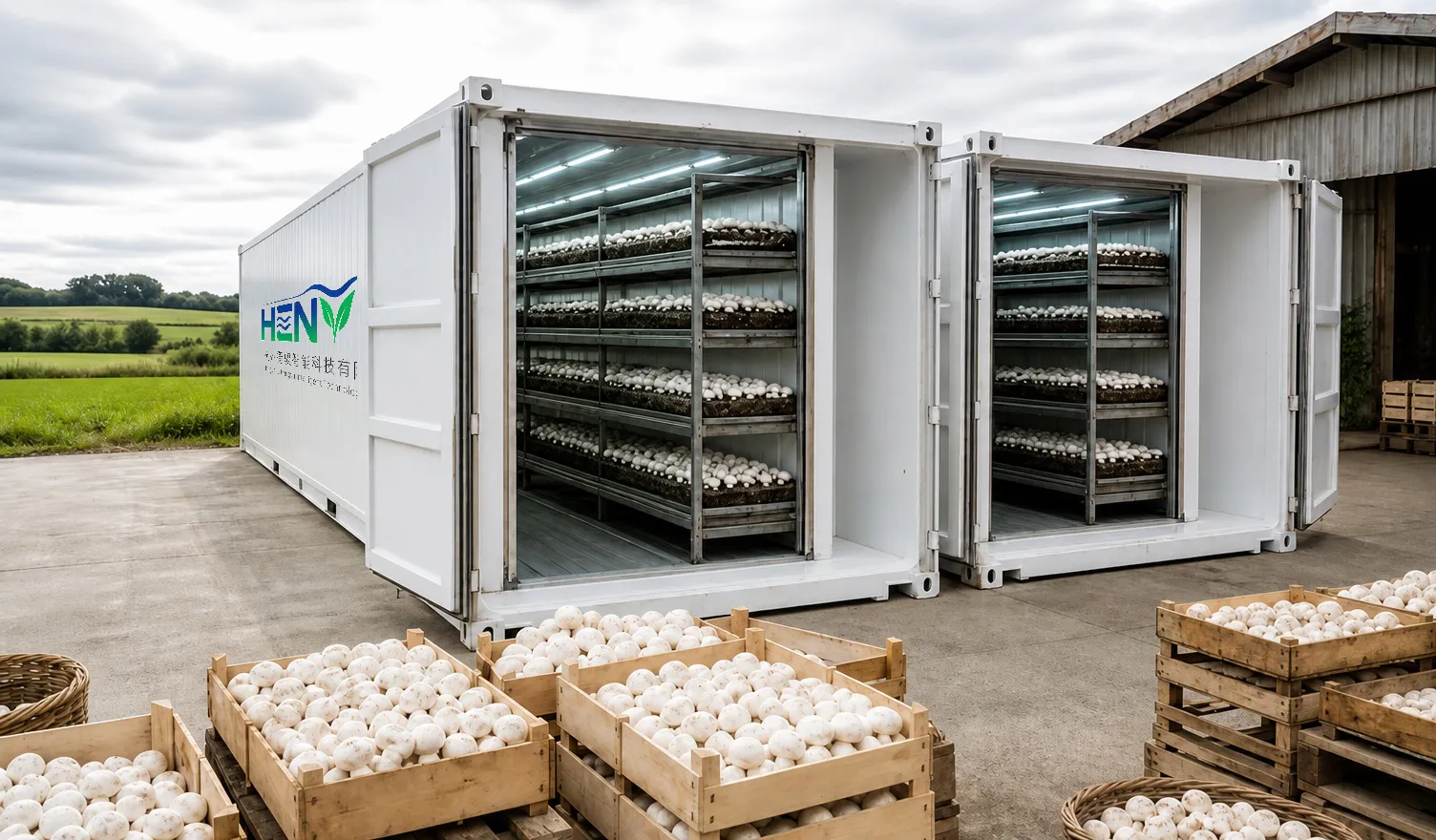
Of all the crops that could live in a container, edible mushrooms are the least surprising fit. A mushroom wants what a container provides: darkness, high humidity, steady temperature, and clean, controlled air. It does not want sunlight. It does not want wind. It does not want the wide swings of a field or the solar gain of a greenhouse. When you put a mushroom into a container, you are not forcing an unnatural crop into a box — you are giving it closer to what it evolved for.
This is why container and purpose-built chamber cultivation of mushrooms has quietly become one of the more commercially serious branches of controlled-environment agriculture, distinct from the leafy-green vertical farms that dominate the press. The economics are different too. Mushrooms command higher prices per kilogram than most vegetables, they have short enough cycles to turn over quickly, and they tolerate the humid, dark conditions that would destroy a lettuce crop.
The basic biology drives the engineering. A mushroom is the fruiting body of a fungus that spends most of its life as a network of filaments, and the grower is really managing that network and then coaxing it to fruit. The cycle runs roughly in phases: substrate preparation, inoculation with spawn, a colonization period during which the mycelium spreads through the substrate, then a shift in conditions — cooler air, a drop in temperature, a specific humidity and carbon dioxide profile — that triggers pinning, the emergence of tiny primordia that become mushrooms. Then comes the flush, the actual harvest, and then, for several species, a rest period before the next flush.
Each of those phases wants its own environment, and the container makes it possible to deliver them on a schedule rather than at the mercy of weather. Colonization generally wants warmth, around 22 to 25 degrees Celsius, and high carbon dioxide, because elevated CO2 suppresses premature fruiting while the mycelium fills the substrate. Fruiting wants a distinct drop — often 15 to 18 degrees Celsius depending on species — plus fresh air, because the carbon dioxide level must fall sharply to allow primordia to form and, critically, because mushrooms are highly sensitive to CO2 during development. Too much CO2 during fruiting and you get long, thin stems and undersized caps, the classic sign of a poorly ventilated grow room.
Humidity is the other governing variable. Mushrooms are about 90 percent water, and they pull that water from the substrate and the air. Relative humidity during fruiting typically needs to sit in the 85 to 95 percent range, which is far above anything a leafy-green farm would tolerate. That level of humidity, combined with the warm substrate and the organic material everywhere, is also a perfect environment for contamination — which is why mushroom cultivation has always placed a heavy emphasis on sanitation. A container's sealed, cleanable envelope becomes an asset here rather than a liability.
Substrate is where a great deal of the commercial reality lives. Commercial growers use pasteurized or sterilized substrates — composted materials for button mushrooms, supplemented hardwood sawdust or straw for oyster and shiitake — and the preparation of that substrate is itself an energy- and labor-intensive operation. A container farm does not eliminate this; it relocates and controls it. What the container does let you do is run the whole cycle on a repeatable schedule, which matters for labor planning and for maintaining a steady supply to buyers.
Species choice defines the business. Oyster mushrooms are fast, forgiving, and productive, fruiting in weeks and tolerating a wide range of conditions, which makes them the entry point for many new growers. Shiitake takes longer and rewards patience with a higher price. Lion's mane and king oyster command premium prices in specialty and culinary markets. Some species are harder to grow indoors at commercial scale, and the honest answer is that the container does not make a difficult mushroom easy; it makes a suitable mushroom reliably repeatable.
The engineering detail that most often trips up new operators is airflow. Mushroom rooms need high humidity but also must remove the CO2 the mushrooms themselves produce and the heat that accompanies their respiration. The result is a ventilation problem where moving humid air without chilling it, and without creating drafts that dry the caps, is genuinely difficult. The usual solution is a controlled exchange of fresh and recirculated air, with the humidity and temperature of the incoming air conditioned before it enters the room, plus careful placement of fans to avoid direct flow onto the fruiting bodies.
Container mushroom farms also benefit from a kind of supply-chain symmetry that leafy-green farms do not. The substrate-inputs, the spawn, the harvest, and the processing can all be co-located. And because mushrooms are increasingly of interest to the same controlled-environment agriculture audience that runs vertical farms, the two systems can share infrastructure and expertise — environmental control, sanitation discipline, and the logistics of moving perishable product to market.
None of this is easy, and the failure rate among new growers is high, mostly for reasons of contamination, inconsistent fruiting, and underestimating the labor of harvesting multiple flushes. But for an operator who wants a high-value crop that actually wants the dark, mushrooms make a compelling case for the container — perhaps more compelling than the leafy greens that usually get top billing.