Both systems grow crops under cover and both beat open-field farming on control and predictability. But they are built on different premises. A greenhouse optimizes sunlight and scale; a container farm optimizes isolation and control. The differences show up most clearly across eight dimensions.
1. Land Footprint and Siting
A greenhouse is a land-based structure. It needs a flat, well-drained site with enough area to justify the build, and its footprint scales with production — more output means more ground. Zoning, access roads, and light exposure all constrain where it can go.
A container farm occupies roughly 30 square meters of floor area per box and can be stacked vertically. It can sit on a rooftop, in a parking lot, inside a warehouse, or next to a distribution centre in the middle of a city. The constraint is not land but power and access, which opens sites a greenhouse simply cannot use.
2. Weather Independence
A greenhouse reduces weather risk; it does not eliminate it. Seasonal light shifts, heat waves, cold snaps, and storms still push the internal climate around, and growers manage that with vents, shade screens, heating, and supplemental lighting.
A container is effectively sealed from the outside. External temperature, humidity, wind, and day length have no direct influence on the crop. Setpoints hold year-round, which makes output far more predictable — and makes it possible to grow a fixed crop calendar regardless of latitude or season.
3. Growing System
Greenhouses are mostly soil-based, whether in-ground beds or containers filled with growing media. Some integrate hydroponics, but soil remains common because it is cheap and forgiving at large scale.
Container farms are essentially always soilless — hydroponic or aeroponic — with roots in a recirculating nutrient solution and an inert medium. This gives tighter control over nutrition and eliminates soil-borne disease, but it also requires more precise management and instrumentation. There is no room for the "soil buffer" that lets a greenhouse absorb small mistakes.
4. Yield per Unit Area
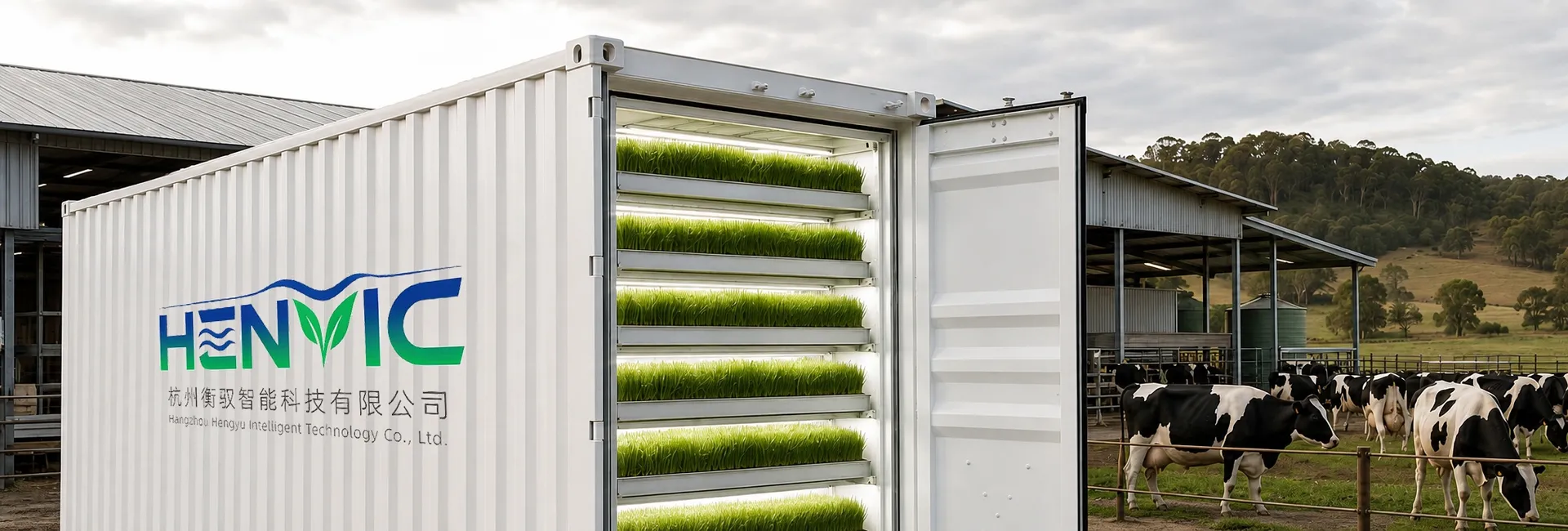
A greenhouse typically produces far more per square meter than a field. A container goes further, because it stacks growing tiers vertically inside a small footprint, often three to five layers, under continuous optimal light rather than passive sunlight.
The comparison depends heavily on how you count. Per square meter of actual growing area, greenhouse and container yields can be comparable. Per square meter of land occupied, the container wins decisively because of vertical stacking — though it achieves this by consuming far more energy per unit of produce.
5. Water and Resource Efficiency
Recirculating hydroponics in a sealed container can cut water use dramatically relative to field irrigation, because runoff is captured and reused and evaporation is limited. Pesticide use is also reduced, since insects and spores are largely excluded by the sealed envelope.
Efficient greenhouses with closed-loop irrigation and condensate recovery can approach similar water efficiency. The gap narrows when the greenhouse is well-managed, but the container has the structural advantage: nothing enters or leaves unless the operator allows it.
6. Energy Consumption and Operating Cost
This is the container's weakest dimension. Grow lights, air conditioning, dehumidification, and pumping run continuously, and electricity is the dominant operating expense. A container farm is closer to a factory than a farm in its cost structure — predictable, but power-hungry.
A greenhouse in a favourable climate uses free sunlight and can rely on passive ventilation for much of the year, making energy costs far lower. In cold or low-light regions, heating and supplemental lighting close the gap, and a greenhouse's energy bill can become substantial. Climate, more than technology, decides which system is cheaper to run.
7. Capital Cost and Deployment Speed
A commercial greenhouse is a capital project: site preparation, foundations, glazing or film, climate systems, and permits, often measured in months to years. Cost per unit of production area tends to be lower at scale, and the structure is designed to last decades.
A container farm is modular and prefabricated. A unit can be delivered and producing within weeks, with far less site work, and additional boxes can be added incrementally as demand grows. Cost per unit of growing area is higher, and retrofitting a used shipping container adds its own engineering burden — insulation, sealing, and HVAC are not trivial.
8. Crops Suited and Scalability
Greenhouses excel at high-value, light-demanding crops at volume: tomatoes, cucumbers, peppers, leafy greens, and ornamentals. They scale economically into large operations and integrate well with existing agricultural supply chains.
Containers are best suited to fast-turn, high-value, compact crops — leafy greens, herbs, microgreens, strawberries, and specialty seedlings — where consistent quality and short local supply chains justify the energy cost. Scaling is modular rather than linear: adding boxes is easy, but the per-unit economics do not improve much with size, since each box carries its own full climate-control load.
How to Read the Comparison
Dimension
Container Farm
Traditional Greenhouse
Land & siting
Minimal, stackable, urban-capable
Land-dependent, site-constrained
Weather independence
Near-total
Partial, managed
Growing system
Soilless, sensors required
Mostly soil, more forgiving
Yield (per land area)
Very high via stacking
High, single layer
Water & inputs
Closed-loop, minimal loss
Good if well-managed
Energy & opex
High, electricity-dominated
Lower in mild climates
Capital & speed
Modular, fast, higher per-area cost
Slower build, cheaper at scale
Crops & scalability
Compact, fast-turn, high-value
Volume crops, scales economically
The two are not competing for the same job. A greenhouse is the right answer when you have land, daylight, and the goal of producing volume at low operating cost. A container is the right answer when you have limited space, a demanding market that values consistency and proximity, and the ability to absorb a high energy bill. The decision usually comes down to three questions: what climate you are in, what crop you are growing, and what the customer is willing to pay for predictability.